If your product leaves the country in a wooden crate, the crate is regulated cargo before it ever holds anything. A raw pine board can carry bark beetles, longhorn borers, and pinewood nematodes across borders, so almost every trading nation now demands that solid-wood packaging be treated and marked before it crosses a frontier. The rulebook is a single international standard, and a crate that ignores it can be refused, fumigated, or sent back at the shipper’s expense. This is a plain walk-through of what that standard asks for, so you can specify an export crate that clears customs the first time.
Why one standard governs wooden crates worldwide
The standard is ISPM 15, short for International Standards for Phytosanitary Measures No. 15, published by the International Plant Protection Convention. Roughly 180 countries enforce it, including the United States, Canada, the European Union member states, China, and Australia, which means it effectively governs any solid-wood crate, pallet, skid, or piece of dunnage moving in international trade. The goal is narrow and specific: kill any pests living in the wood so packaging does not become a vector for invasive species. It does not care what you ship inside the crate; it cares only about the wood the crate is built from.
Two points trip up first-time exporters. The rule applies to the packaging, not the goods, so even a shipment of finished metal parts needs a compliant crate. And it applies at the border of the destination country, not your own, so a crate that is fine for a domestic move can be rejected the moment it is booked for export.
What “heat treated” actually means
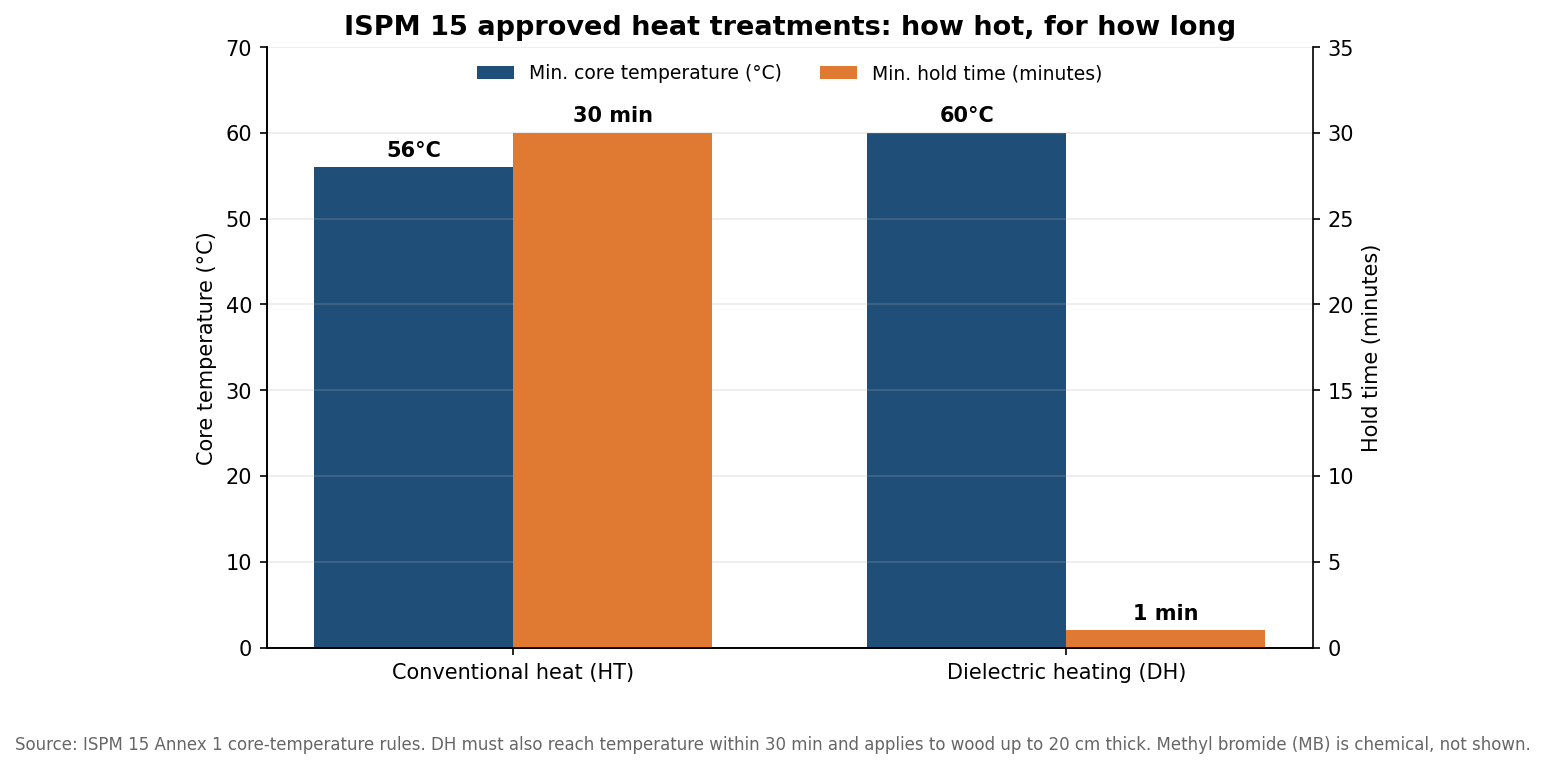
The most common way to satisfy ISPM 15 is heat treatment, abbreviated HT. The wood has to reach a core temperature of at least 56 degrees Celsius, about 133 degrees Fahrenheit, and hold there for a minimum of 30 continuous minutes. Note the word core: it is not the surface or the kiln air that matters but the center of the thickest piece, which is why treaters probe the densest members. A newer option, dielectric heating (DH), uses microwave or radio-frequency energy to drive the core to at least 60 degrees Celsius for one continuous minute, reaching temperature within 30 minutes, and is limited to wood up to 20 centimeters thick.
The chemical alternative is methyl bromide fumigation, marked MB, but its use is being phased down in many regions because it depletes ozone, so heat treatment is the default most buyers should expect. Heat treatment also leaves the wood dry and dimensionally stable, which is a quiet advantage for a crate that will sit in a humid container for weeks. Treatment does not make wood waterproof or rot-proof; it is a one-time pest kill, and wood can be re-infested later if it is stored badly, which is one reason the marking and handling rules exist.
Which crates need treatment, and which are exempt
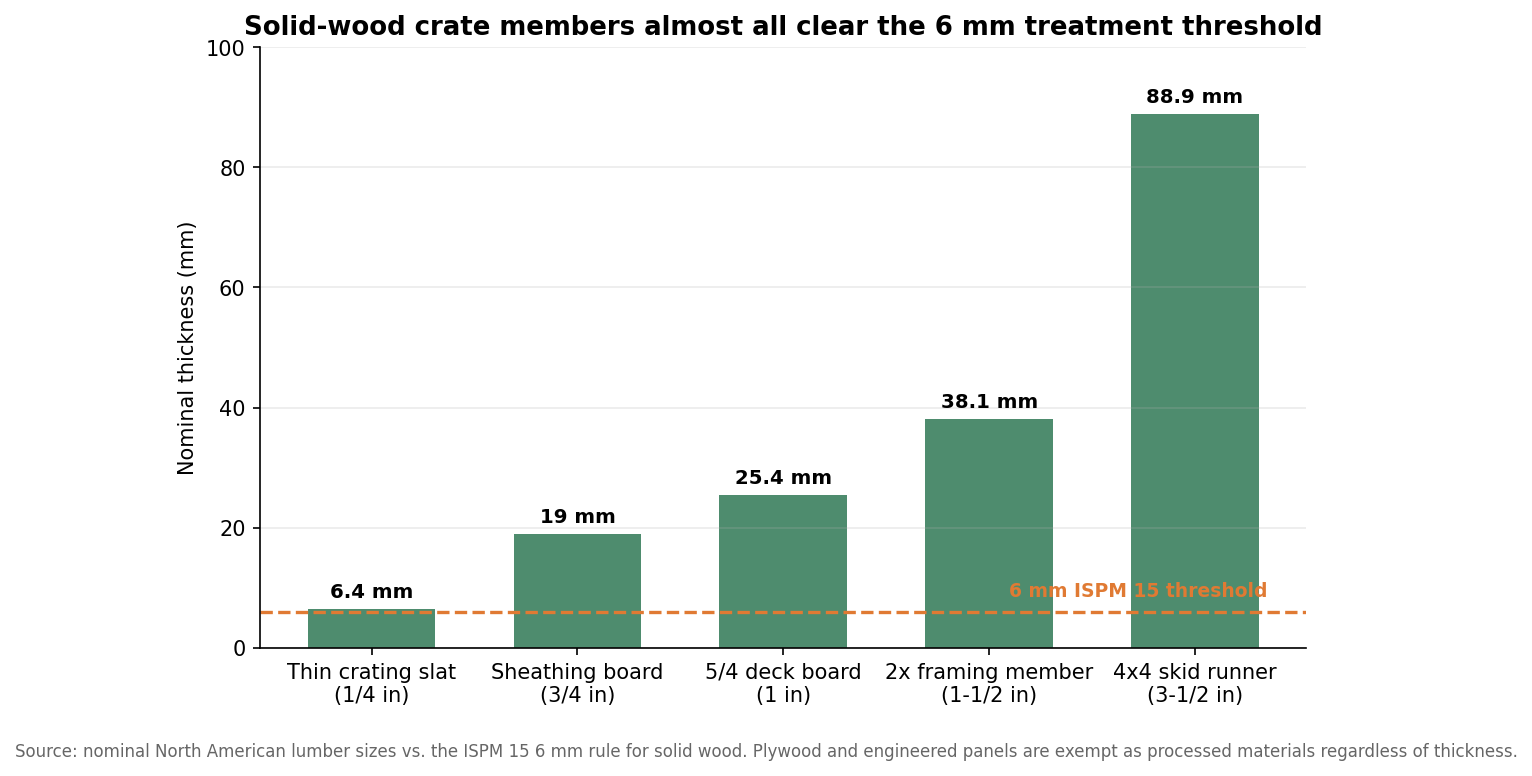
ISPM 15 covers solid-wood components thicker than 6 millimeters. That threshold sounds generous until you measure real crate lumber: a three-quarter-inch sheathing board is 19 millimeters, a two-by framing member is about 38 millimeters, and a four-by-four skid runner is nearly 90 millimeters. Every structural piece in a normal solid-wood crate clears the line comfortably, so in practice a solid-wood export crate always needs treatment.
The important exemption is by material rather than size. Plywood, oriented strand board, and other engineered or processed panels are exempt because the heat and adhesives used to manufacture them already destroy pests. That is a genuine specifying lever: a crate clad or built in plywood can sidestep the treatment-and-stamp requirement on those panels, though any solid-wood framing or skids still fall under the rule. Compliant wood must also be debarked before treatment, since bark is where many insects live and lay eggs, so a small amount of residual bark is tolerated but strips beyond the allowed size are not.
Reading the stamp before your crate ships
A treated crate is proven by a mark, not a certificate that travels separately. The stamp carries the IPPC wheat-stalk logo, a two-letter ISO country code for where the treatment happened, a unique registration number for the facility that treated the wood, and a treatment code: HT for heat treatment, DH for dielectric heating, or MB for methyl bromide. The mark has to be legible, permanent, and applied to at least two opposite sides of the finished crate. It should never be handwritten or drawn in a color that suggests a food or hazard marking.
When you receive an export crate, the fastest quality check is to confirm the stamp is present on two sides, that the treatment code matches what you ordered, and that the facility number is printed rather than penciled. A missing or ambiguous stamp is the single most common reason compliant-looking crates get held, because the inspector at the destination port reads the wood, not your paperwork.
Specifying an export-ready crate
Bring three things to the conversation and the rest follows. State that the crate is for international export so the builder treats and stamps it rather than assuming a domestic job. Give the gross weight and the dimensions of what goes inside, since those drive lumber gauge and whether you need a heavier skid. And decide early between a solid-wood build and a plywood-clad build, because that choice changes both the treatment scope and the crate’s own weight, which you pay to ship.
Treatment and stamping add a step to the build, so an export crate generally carries a modest surcharge and a little extra lead time over a domestic one; the exact figures depend on size, volume, and how the builder schedules its treatment, so treat any single number as indicative and confirm it on a quote. The cost of getting it wrong is not modest, though. A non-compliant crate at the destination can be rejected, fumigated, or destroyed on arrival, with the fees and the delay landing on the shipper. Specifying the standard up front is far cheaper than discovering it at a foreign port.