A crate is not one thing. The word covers everything from a slatted frame that lets a motor breathe to a fully sheathed plywood box built to cross an ocean, and the gap between them is measured in dollars, pounds, and whether your shipment arrives intact. Once you know what goes inside and how far it travels, the style of crate almost chooses itself. This guide walks through the common construction styles, what each one protects against, and how to match the build to the load rather than paying for enclosure you do not need or skimping on protection you do.
Why the construction style matters before the wood
Style is the first decision, ahead of species or thickness. A crate style is really a set of trade-offs among protection, weight, ventilation, and cost. A fully enclosed build keeps out weather, dust, and prying hands but adds material, tare weight, and freight cost. An open, slatted build sheds weight and price and lets air move through, at the expense of exposing the contents. Ventilation sounds minor until you are shipping something that can trap condensation or that needs to be inspected without being unpacked. Weight matters because dimensional-weight freight pricing charges you for the box as well as the goods. Getting the style right is what keeps a crate from being both overbuilt and underprotective at the same time.
Fasteners belong in the same early conversation. Nails are fast and common, but ring-shank nails, screws, or staples hold better under vibration and repeated handling, and a crate meant to be opened and reclosed for inspection benefits from screwed panels or a lag-bolted lid. The joining method is part of the rated strength, not an afterthought, which is why the recognized standards specify fastening as tightly as they specify sheathing.
Open and slatted crates for rugged loads
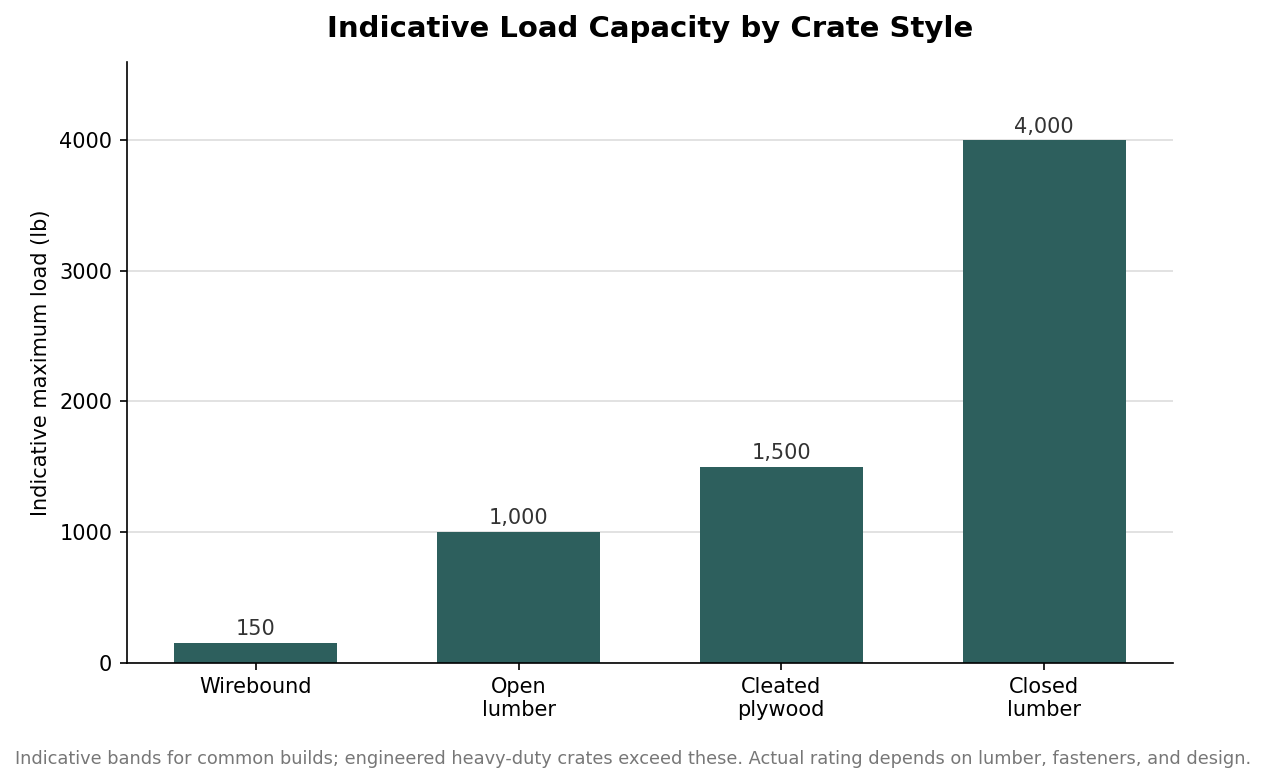
Open crates are framed cages with gaps between the sheathing boards. They are built around a lumber skeleton and sheathed only partially, which makes them the lightest and least expensive way to immobilize a sturdy item. They suit machinery, engine blocks, fabricated steel, and other goods that are not harmed by exposure and do not need to be hidden. The open faces cut weight and cost, allow a forklift operator to see the load, and let the contents dry rather than sweat. ASTM D6039 is the recognized specification covering open and covered wood crates, and it exists precisely because these builds are engineered to a load rather than nailed together by feel. As a planning figure, common open lumber builds handle loads on the order of a thousand pounds, with heavier engineered versions going well beyond that.
Closed and covered crates for weather and security
Closed crates sheath every face, turning the frame into a solid box. When the contents need protection from rain, road spray, dust, or curious hands, full sheathing is the answer. Covered lumber crates carry the highest indicative load ratings of the common styles because the continuous walls add rigidity on top of the internal frame, which is why they are the default for dense, valuable, or fragile freight that will be handled repeatedly. The chart below shows how indicative load capacity climbs as you move from a light wirebound build up to a closed lumber crate. Treat the numbers as bands for typical construction, not fixed limits, because a properly engineered heavy-duty crate can be designed far past them.
Cleated plywood boxes for a strong, lighter export shell
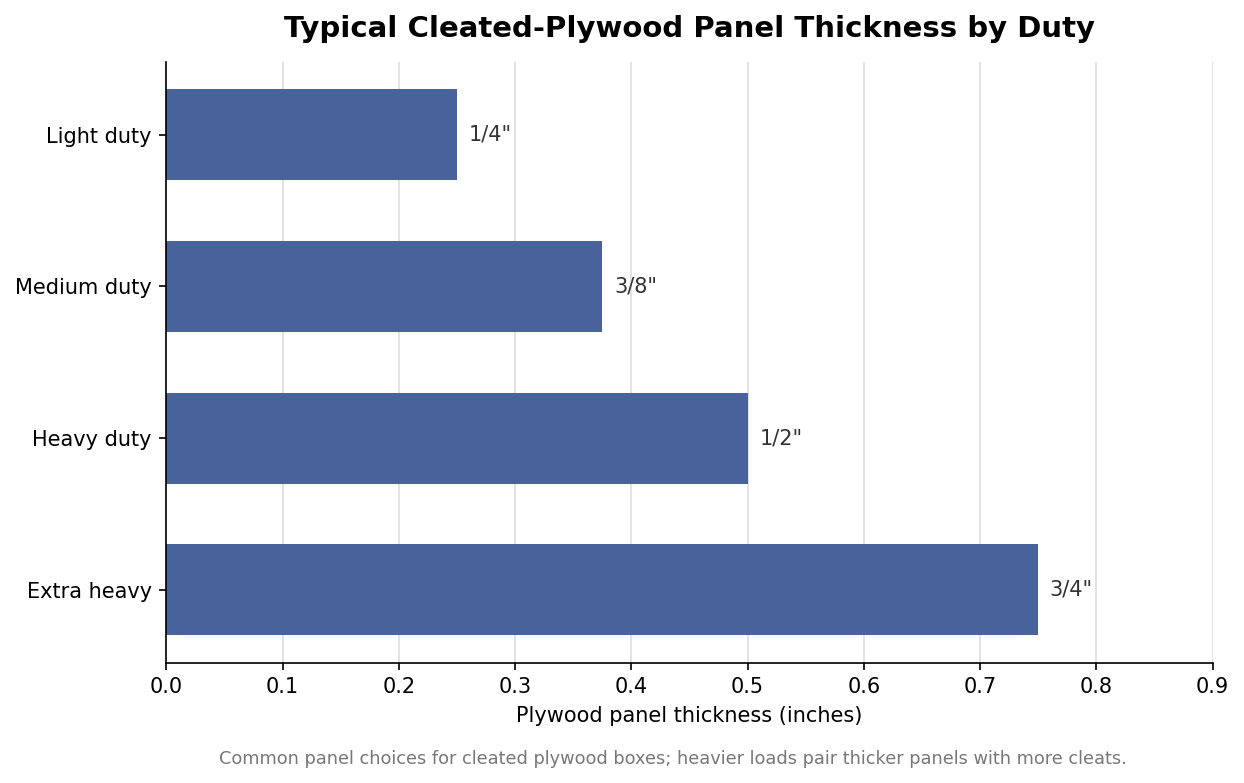
Cleated plywood boxes trade solid boards for plywood panels braced by wood cleats. The panels give you a smooth, continuous wall while the cleats supply the stiffness that a bare sheet lacks, and the result is often lighter than a solid-lumber crate of the same strength. That weight advantage is why cleated plywood is a workhorse for export, where freight is priced by weight and volume and where ASTM D6251, the specification for wood-cleated panelboard shipping boxes, sets the construction rules. Panel thickness is the main lever: lighter loads ride on quarter-inch panels, while heavy contents call for half-inch or thicker plywood paired with more closely spaced cleats. The second chart shows how panel thickness typically steps up with duty.
Wirebound crates, and how a crate differs from a pallet
Wirebound crates are the light end of the range. Thin wood faces are stitched together with steel wire so the crate can ship flat and be assembled quickly, which suits produce, light parts, and anything where low cost and collapsibility outweigh brute strength. They are not built for heavy or high-value freight, and the indicative load band reflects that. Their real advantage is logistics: because they ship and store flat, they save space and freight on the inbound side and assemble in seconds when you need them. It is also worth being clear about a distinction that trips up a lot of buyers: a pallet is only a base for forklift handling, and a skid is a base without bottom deck boards, whereas a crate encloses the load with sides and usually a top. Many heavy crates are in fact built on a skid base, combining forklift access underneath with full enclosure above. If your goods need containment rather than just a platform to lift from, you need a crate, and choosing the style above is the real decision.
Put the pieces together in order. Start with the weight and fragility of the contents and whether they must be sealed from weather or left to breathe. That points you to open, closed, cleated plywood, or wirebound. Then size the crate to the load, set panel or sheathing thickness to the duty, and, if the shipment leaves the country, confirm the build meets the export standard and the wood is ISPM 15 compliant. Specified in that sequence, the crate protects what matters without carrying cost you do not need.