When buyers spec a custom crate, they tend to ask about size and style first and material last, if at all. That order is backward. The wood you build a crate from decides what it can carry, what it weighs, how it survives a humid container, and, for anything crossing a border, whether it needs a heat-treatment stamp before it can ship. Three materials do almost all the work in wooden crating: solid lumber, plywood, and oriented strand board. They are not interchangeable, and knowing which does what is the difference between a crate that protects the load and one that fails on the forklift or gets held at the port.
Here is what each material is actually for, and how to combine them without overpaying or overbuilding.
Two jobs, three materials
A crate has a skeleton and a skin, and different woods handle each. The skeleton, the base, skids, corner posts, and cleats, carries the load and takes the abuse from straps and forks, and that is the job of solid dimensional lumber. The skin, the walls and top that enclose the contents, is usually a sheet good like plywood or OSB. Treating these as one decision is a common and costly error: a panel makes a poor structural frame, and framing lumber makes an expensive, heavy wall. The right crate uses each material where its strengths line up with the job.
Solid lumber: the structural bones
Solid softwood lumber, typically pine, spruce, or Douglas fir, is what gives a crate its load rating. It holds fasteners hard, resists the point loads of a strap or a fork tine, and can be sized up for heavy or concentrated weights by moving to thicker stock or adding cleats. Nothing else in the crate does this job as well, which is why even a panel-walled crate still rides on a solid-wood base and frame.
The trade-off is weight and, for exporters, paperwork. Solid wood is the heaviest option per board, and because raw wood can harbor insects, any solid wood packaging thicker than six millimeters must be heat-treated and stamped with the IPPC mark to leave the country under international rules. That is a real cost and lead-time factor, and it falls specifically on the solid-lumber portion of your crate.
Plywood: the all-around panel
Plywood is the default skin for a reason: it delivers the best balance of strength, weight, and durability of the sheet goods. Its cross-laminated veneers give it even strength in both directions, it grips nails and screws far better than OSB because the fasteners bite into continuous plies, and it presents a clean, finished face that takes printing or branding well. Crucially, it behaves under moisture: plywood absorbs water more evenly and typically returns to its original thickness once it dries, so a crate that gets rained on or sweats in a container does not come apart at the seams.
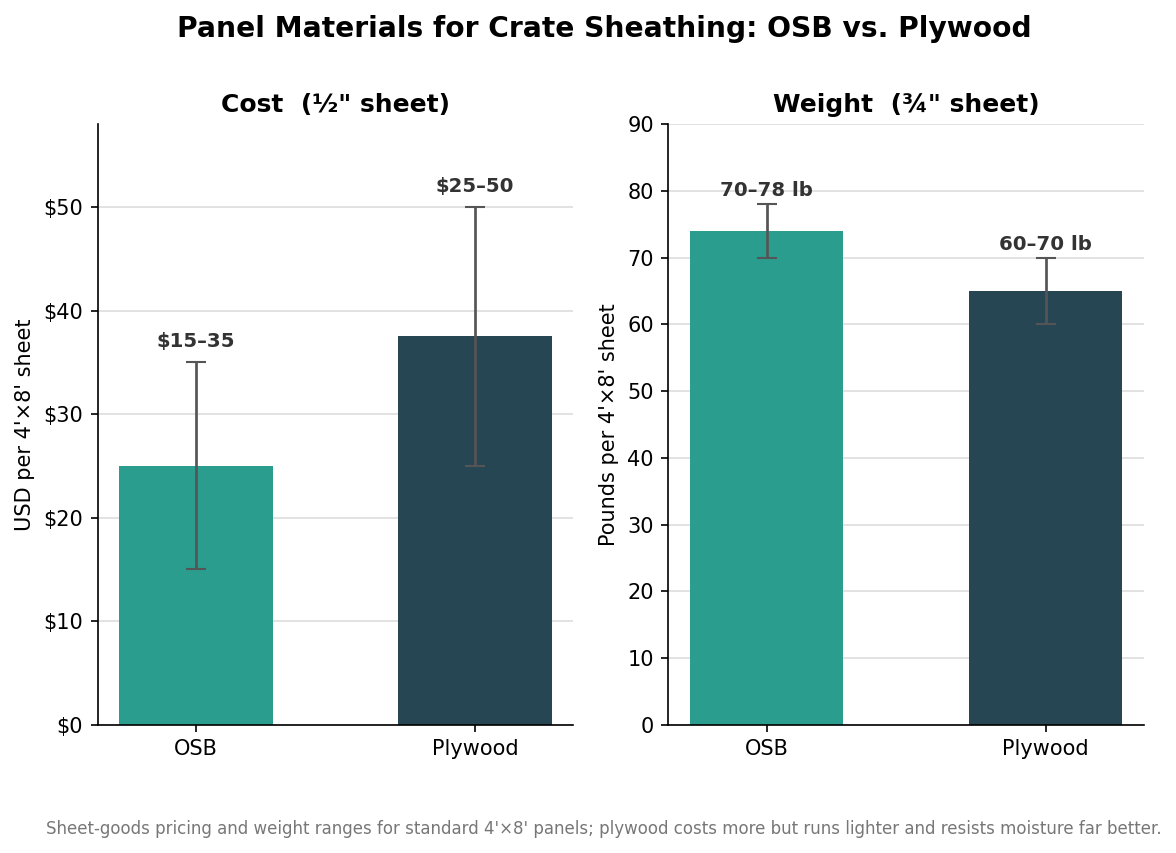
You pay for those properties. A half-inch four-by-eight sheet of plywood runs roughly $25 to $50 against about $15 to $35 for OSB, so plywood is the pricier panel. It is also lighter, at roughly 60 to 70 pounds for a three-quarter-inch sheet versus about 70 to 78 for OSB, which matters when freight is priced by weight. For export crates, moisture-prone routes, reusable crates, or anything where appearance counts, plywood is usually worth the premium.
OSB: the budget panel and where it fails
Oriented strand board is the cost play, and within its limits it is a legitimate one. Made from compressed wood strands, OSB carries structural ratings comparable to plywood for flat-panel use and costs meaningfully less per sheet, which adds up fast across a large run of crates. For dry, domestic, one-way shipments where the crate is a disposable protective shell, OSB does the job for less money.
Its weakness is water, and the failure is not graceful. Standard OSB swells at the edges when it gets wet, and that swelling is often permanent, so a panel that takes on moisture in transit stays deformed rather than recovering the way plywood does. It also holds fasteners less firmly and runs heavier than plywood sheet for sheet. Use it where conditions are controlled and the crate will not see rain, humidity, or a long ocean leg; avoid it where any of those are in play.
The export angle: engineered wood skips the stamp
Here is the material insight that saves exporters real money and time. The ISPM 15 heat-treatment and stamping rule applies to solid wood packaging, but manufactured panels, plywood, OSB, and particle board, are exempt, because the manufacturing process eliminates the pest risk that raw wood carries. That means the sheathing on a panel-skinned crate does not need treatment or a stamp; only the solid-wood frame, skids, and cleats do.
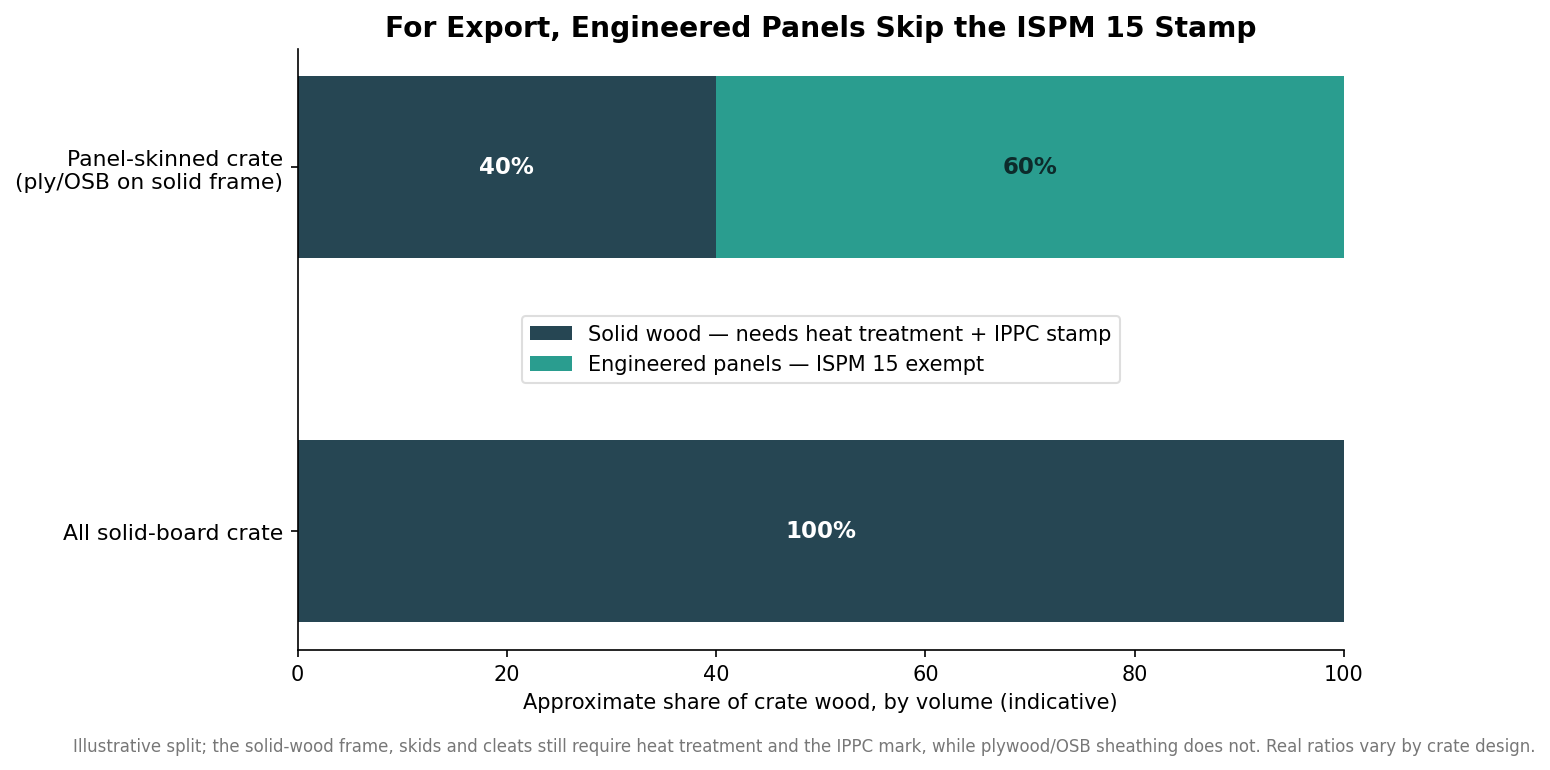
The practical consequence is that building the walls from plywood or OSB shrinks the portion of the crate that has to run through heat treatment and certification, which can trim both cost and lead time on export orders. An all-solid-board crate, by contrast, has to be treated and stamped in its entirety. The shares above are indicative and shift with the design, but the principle is firm: put engineered panels where you can, keep solid lumber to the structural frame that genuinely needs it, and you meet the export rule while carrying the least treatment burden. Spec the material first, and the size, style, and compliance decisions get easier from there.