Logo Artwork for Custom Wooden Crates: Files, Placement and Proofs
The best artwork for custom wooden crates is a clean vector logo with solid shapes and no fine hairlines, sized for the crate panel it will sit on. Send what you have to Get Custom Crates; the team turns it into a free mockup within 24 hours, adjusts it for wood grain, and you approve before anything is cut, burned or printed.
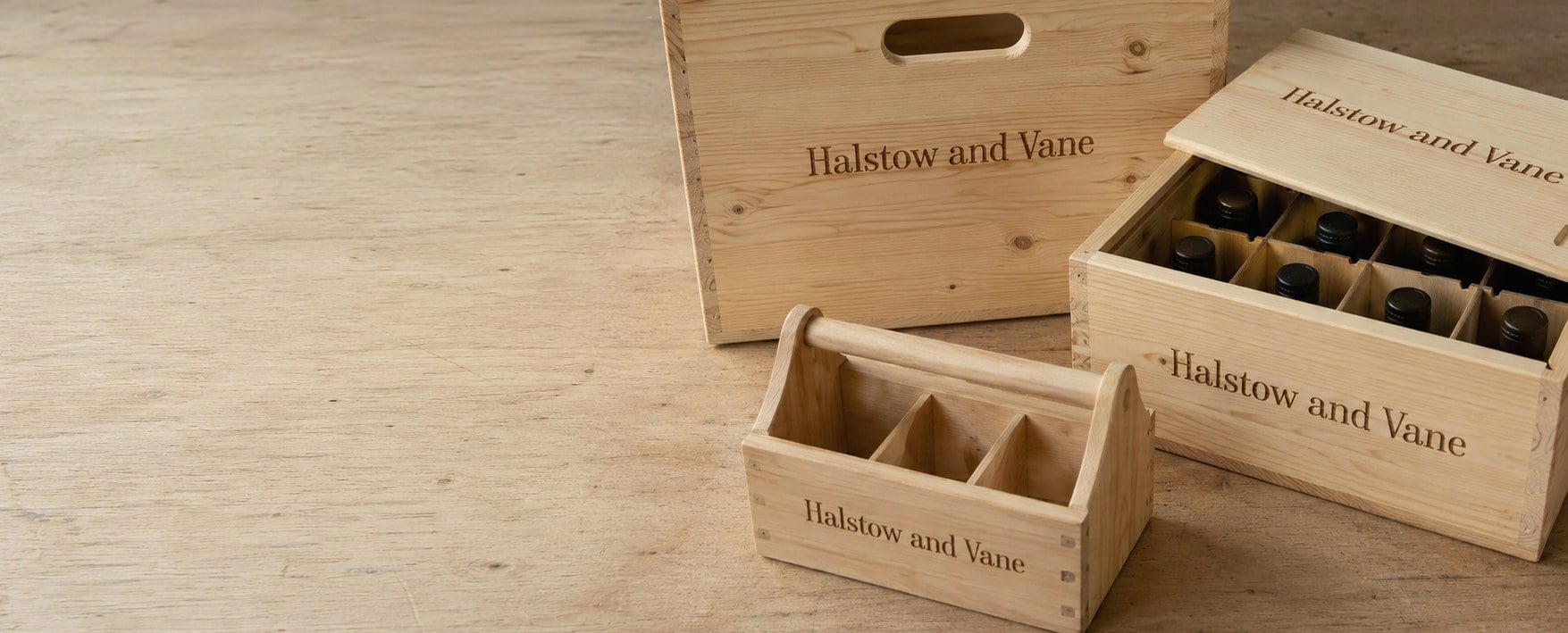
- Vector files (AI, EPS, SVG or a vector PDF) give the sharpest engraved or printed crate logo.
- Wood grain softens fine detail, so bold shapes and thicker strokes read best on crates.
- Get Custom Crates sends a free mockup within 24 hours with unlimited free revisions.
- You pay nothing until you approve the design; minimum order is 12 crates.
- Standard turnaround is about 2 weeks after proof approval.
What logo file should I send for custom wooden crates?
The ideal logo file for custom wooden crates is a vector file: AI, EPS, SVG or a PDF exported from design software with the shapes kept as paths. Vector artwork describes your logo as lines and curves rather than pixels, so it stays crisp when it is scaled up to fill the long side of a shipping crate or scaled down for the end panel of a mini caddy.
If you only have a JPG or PNG, send it anyway. Get Custom Crates reviews every file, and a high-resolution image with a clear edge between the logo and the background can often be rebuilt as clean artwork for the proof. What does not work well is a tiny image pulled from a website header, a screenshot of a social profile, or a photo of a printed sign taken at an angle.
- Best: the original vector file from whoever designed the logo.
- Good: a large PNG on a transparent background.
- Workable: a sharp JPG with strong contrast, which the team can trace for the mockup.
- Avoid: small, blurry or cropped images and files with the logo baked into a photo.
Include any brand colors you want matched and the fonts used in the logo if you know them. That detail shortens the revision loop on the mockup.
How does wood grain change the way a crate logo looks?
Wood grain changes a crate logo more than most buyers expect, because the surface is not a flat white page. Grain lines, knots and the natural color shift between boards all sit behind your artwork, and they compete with thin lines, small type and delicate gradients. Artwork that looks elegant on a business card can turn muddy on a pine crate side.
Engraving and burning darken the wood where the logo sits, so contrast depends on how light the board is to begin with. Printing lays ink on top of the grain, which keeps colors closer to your brand palette but still lets texture show through on lighter coverage. Either way, the logo that performs best on crates has bold shapes, generous spacing between letters and strokes that are thick enough to survive the texture.
- Drop taglines and fine print from the crate version of the logo.
- Replace soft gradients with solid fills.
- Thicken hairline outlines or remove them.
- Use a simplified icon on small crates and the full lockup on large ones.
Get Custom Crates flags these issues on the mockup instead of letting them surprise you on delivery, and suggests a crate-ready version of the mark when the original is too detailed.
Where should a logo go on a custom crate?
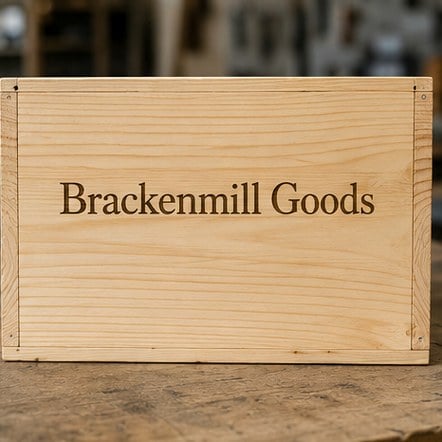
Logo placement on custom crates should follow how the crate will be seen in use. A retail display crate is viewed from the front at eye level, so the front panel carries the logo. A gift crate is often opened from the top, so a lid mark or an inside-lid message gets attention. A shipping crate is handled from every side, so the logo usually goes on the long sides where it is read in a warehouse aisle or on a truck.
| Crate type | Primary logo position | Secondary option |
|---|---|---|
| Retail display crates | Front panel facing the shopper | Short end panels when crates are stacked sideways |
| Gift and hamper crates | Lid or front panel | Inside lid for a message or event name |
| Farm and market crates | Long side facing the customer | End panel near the hand holds |
| Wine crates | Sliding lid | Front end panel |
| Heavy-duty shipping crates | Long sides | Handling marks and contact details on the ends |
| Mini crates and caddies | Front panel or handle area | Back panel for a second mark |
Remember that slatted crates have gaps between boards. A logo placed across a gap gets split, so the mockup positions the mark on a solid board or on the solid end panel where possible.
Should a crate logo be engraved, burned or printed?
The decoration method for a crate logo depends on the artwork and on how the crate will live. Engraved and burned logos become part of the wood, so they suit crates that get handled, washed or carried outdoors, and they reward simple one-color marks. Printed logos carry color, which matters when brand recognition depends on a specific shade or when the artwork has several colors.
Get Custom Crates already covers durability differences in a separate guide, so for artwork the practical rule is this: if your logo only works in full color, plan on printing; if a single-color version of your logo still reads clearly, engraving or burning will give a natural, premium finish. Many buyers keep both versions on file, a color lockup for printed retail crates and a single-color mark for engraved gift crates.
Tell the team where the crates are headed when you request a quote. The mockup will show the method that suits both your artwork and the job the crate has to do.
How does the free crate mockup and proof process work?
The crate mockup from Get Custom Crates is a free visual proof that shows your artwork on the crate style you picked, in the position and method you chose. You receive the mockup within 24 hours of sending your request and artwork, and revisions are unlimited and free. Nothing is charged until you approve the design.
- Send your request: crate style, rough quantity, intended use and your logo file through the quote form.
- Receive the mockup: within 24 hours, showing placement, method and any artwork adjustments for wood grain.
- Request changes: move the logo, resize it, swap to a simplified mark or change the method. Revisions are free and unlimited.
- Approve: production starts only after your approval, and standard turnaround is about 2 weeks.
Faster turnaround is available with express shipping when a date is tight. Mention your deadline in the first message so the team can plan the proof cycle around it.
What should you check before approving a crate proof?
Before approving a crate proof, check the details that are expensive to fix after production: spelling, logo version, position and scale. A proof is the last moment to catch an old logo, a missing apostrophe or a mark that sits across a slat gap.
- Spelling and names: read every word aloud, including web addresses and event names.
- Logo version: confirm it is the current mark, not an older file someone had saved.
- Scale: picture the crate in its real setting; a logo that looks large on screen can feel small on a market table.
- Position: make sure the logo faces the viewer once the crate is stacked, filled or displayed.
- Method: confirm engraving, burning or printing matches what you expect.
- Variations: if different crates in the order carry different marks or names, check each version.
Ask questions on the proof rather than approving with doubts. Unlimited free revisions exist so the crates arrive exactly as intended.
What are the most common crate artwork mistakes?
The most common crate artwork mistakes come from treating a wooden crate like paper. Small type, thin outlines and busy backgrounds are the usual culprits, followed by logos placed without thinking about how the crate is actually used.
- Too much text: a full address, tagline and phone number crowd a crate panel. Keep the brand mark and, at most, a web address.
- Low-contrast colors: pale inks and light tints can disappear into light wood.
- Background boxes: a logo saved with a white rectangle behind it prints or engraves that box. Ask for the transparent version.
- Ignoring slats: artwork centered on an open slatted side can fall across a gap.
- Wrong scale for crate size: the same artwork rarely suits both a mini caddy and a large shipping crate.
None of these mistakes is hard to fix at the mockup stage. Get Custom Crates points them out on the proof so you can decide before production, and you can request a custom quote with whatever artwork you have today.
Frequently asked questions
What file format is best for a logo on custom wooden crates?
A vector file is best for a logo on custom wooden crates, such as AI, EPS, SVG or a PDF with the shapes kept as paths. Vector artwork scales cleanly from a mini caddy to a large shipping crate without blurring. If you only have a PNG or JPG, send it anyway, because Get Custom Crates can often rebuild a sharp image as clean artwork for the free mockup.
Can I order custom wooden crates if I only have a low-resolution logo?
Custom wooden crates can still be ordered when your logo is low resolution, but the artwork usually needs to be redrawn first. Send the best version you have, plus any older files or printed samples. The team reviews it, flags what is too blurry to reproduce, and shows a cleaned-up version on the free mockup so you can approve it before anything is produced.
Will fine lines and small text show up on a wooden crate?
Wooden crates soften fine lines and small text because grain, knots and color variation sit behind the artwork. Thin outlines can break up and tiny letters can fill in, especially when engraved or burned. For crate branding, use the bold version of your logo, drop small taglines and keep strokes thick. Get Custom Crates flags detail that is too fine on the mockup.
Can a logo with gradients or photos go on custom crates?
Custom crates handle solid shapes far better than gradients or photographic artwork. Engraving and burning turn gradients into uneven tone, and printing over wood grain mutes subtle color blends. The usual fix is a solid-fill version of the logo for crate use. Get Custom Crates can suggest a simplified mark on the free mockup so your brand still reads clearly on the wood.
Where does the logo usually go on a slatted crate?
A logo on a slatted crate usually goes on a single solid board or on the solid end panel, so the artwork is not split by the gaps between slats. For larger marks, wider boards or a solid front panel can be specified. The mockup from Get Custom Crates shows the exact position, and you can move or resize the logo as often as you like before approving.
Can each crate in one order carry a different name or logo?
Crates in one order can carry different names or marks, for example separate store locations, event sponsors or recipient names on gift crates. List each variation when you request a quote and supply the artwork or text for every version. The 12-crate minimum applies to the order, and each variation is shown on the mockup so you can check every name before approval.
Do I need a designer before ordering branded wooden crates?
Branded wooden crates do not require you to hire a designer first. Send your existing logo, even if it is a rough file or a sketch, and Get Custom Crates prepares crate-ready artwork for the free mockup within 24 hours. If the mark needs simplifying for wood, the team proposes changes, and you approve or revise them as many times as needed at no cost.
How many times can I revise a crate mockup?
Crate mockup revisions are unlimited and free at Get Custom Crates. You can move the logo, change its size, switch between engraving and printing, swap to a simpler mark or correct text as often as you need. Production only starts after you approve the final proof, and you pay nothing until that approval, so there is no pressure to sign off early.
Can brand colors be matched on printed wooden crates?
Printed wooden crates can carry your brand colors, though wood tone and grain affect how a color looks once it is on the board. Light inks may look softer on natural wood than on white paper. Share your brand color references with your artwork, and Get Custom Crates will show the colors on the mockup and flag any shade likely to lose contrast against the crate.
Should the logo on a gift crate go on the lid or the front?
A logo on a gift crate usually works best on the lid when the crate is handed over closed and opened from the top, and on the front panel when the crate sits on a shelf or table. Some buyers use both, with the brand on the front and a message inside the lid. Get Custom Crates shows each option on the free mockup.
What happens if I notice a mistake after approving a crate proof?
A mistake noticed after approving a crate proof should be reported to Get Custom Crates immediately, because production begins soon after approval. The safest approach is to check spelling, logo version, placement and scale carefully on the mockup before you approve. Since revisions before approval are free and unlimited, take the time to ask questions while changes cost nothing.
Can I reuse my crate artwork for a reorder later?
Crate artwork approved for an order can be reused when you reorder, which keeps branding consistent across seasons and locations. Mention the earlier order when you request a new quote and say whether anything should change, such as a new logo version, a different crate style or an added name. A fresh mockup is still provided so you can confirm everything before production starts.
Get a free mockup for your crates
Send your logo or idea and the quantity you have in mind. Get Custom Crates returns a free mockup within 24 hours, you approve the design before anything is produced, and standard turnaround is about two weeks with faster options available. Get a custom quote.