Category: Uncategorized

  • Crate Lumber vs. Plywood vs. OSB: Choosing the Right Wood for the Job

    Crate Lumber vs. Plywood vs. OSB: Choosing the Right Wood for the Job

    When buyers spec a custom crate, they tend to ask about size and style first and material last, if at all. That order is backward. The wood you build a crate from decides what it can carry, what it weighs, how it survives a humid container, and, for anything crossing a border, whether it needs a heat-treatment stamp before it can ship. Three materials do almost all the work in wooden crating: solid lumber, plywood, and oriented strand board. They are not interchangeable, and knowing which does what is the difference between a crate that protects the load and one that fails on the forklift or gets held at the port.

    Here is what each material is actually for, and how to combine them without overpaying or overbuilding.

    Two jobs, three materials

    A crate has a skeleton and a skin, and different woods handle each. The skeleton, the base, skids, corner posts, and cleats, carries the load and takes the abuse from straps and forks, and that is the job of solid dimensional lumber. The skin, the walls and top that enclose the contents, is usually a sheet good like plywood or OSB. Treating these as one decision is a common and costly error: a panel makes a poor structural frame, and framing lumber makes an expensive, heavy wall. The right crate uses each material where its strengths line up with the job.

    Solid lumber: the structural bones

    Solid softwood lumber, typically pine, spruce, or Douglas fir, is what gives a crate its load rating. It holds fasteners hard, resists the point loads of a strap or a fork tine, and can be sized up for heavy or concentrated weights by moving to thicker stock or adding cleats. Nothing else in the crate does this job as well, which is why even a panel-walled crate still rides on a solid-wood base and frame.

    The trade-off is weight and, for exporters, paperwork. Solid wood is the heaviest option per board, and because raw wood can harbor insects, any solid wood packaging thicker than six millimeters must be heat-treated and stamped with the IPPC mark to leave the country under international rules. That is a real cost and lead-time factor, and it falls specifically on the solid-lumber portion of your crate.

    Plywood: the all-around panel

    Plywood is the default skin for a reason: it delivers the best balance of strength, weight, and durability of the sheet goods. Its cross-laminated veneers give it even strength in both directions, it grips nails and screws far better than OSB because the fasteners bite into continuous plies, and it presents a clean, finished face that takes printing or branding well. Crucially, it behaves under moisture: plywood absorbs water more evenly and typically returns to its original thickness once it dries, so a crate that gets rained on or sweats in a container does not come apart at the seams.
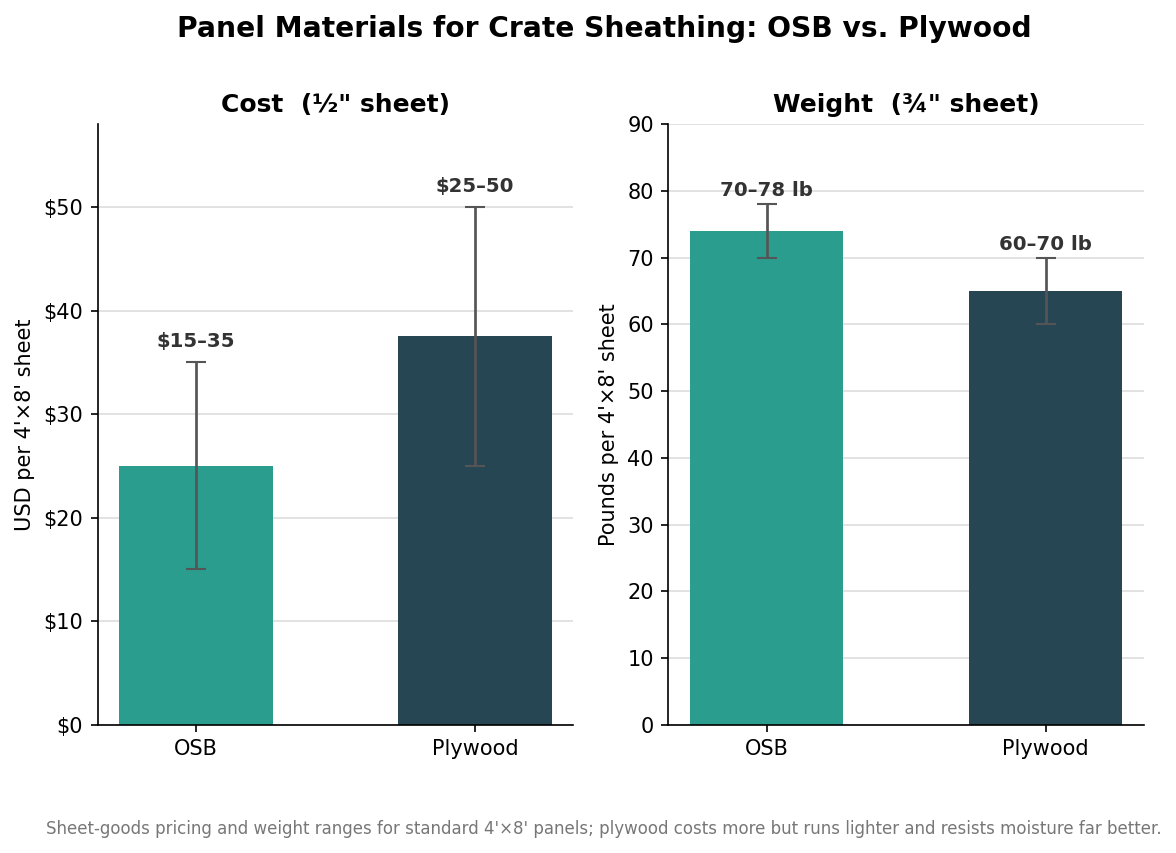
    Two bar charts comparing OSB and plywood crate sheathing on cost per 4x8 half-inch sheet and weight per 4x8 three-quarter-inch sheet
    Plywood costs more per sheet than OSB but runs lighter and handles moisture far better.

    You pay for those properties. A half-inch four-by-eight sheet of plywood runs roughly $25 to $50 against about $15 to $35 for OSB, so plywood is the pricier panel. It is also lighter, at roughly 60 to 70 pounds for a three-quarter-inch sheet versus about 70 to 78 for OSB, which matters when freight is priced by weight. For export crates, moisture-prone routes, reusable crates, or anything where appearance counts, plywood is usually worth the premium.

    OSB: the budget panel and where it fails

    Oriented strand board is the cost play, and within its limits it is a legitimate one. Made from compressed wood strands, OSB carries structural ratings comparable to plywood for flat-panel use and costs meaningfully less per sheet, which adds up fast across a large run of crates. For dry, domestic, one-way shipments where the crate is a disposable protective shell, OSB does the job for less money.

    Its weakness is water, and the failure is not graceful. Standard OSB swells at the edges when it gets wet, and that swelling is often permanent, so a panel that takes on moisture in transit stays deformed rather than recovering the way plywood does. It also holds fasteners less firmly and runs heavier than plywood sheet for sheet. Use it where conditions are controlled and the crate will not see rain, humidity, or a long ocean leg; avoid it where any of those are in play.

    The export angle: engineered wood skips the stamp

    Here is the material insight that saves exporters real money and time. The ISPM 15 heat-treatment and stamping rule applies to solid wood packaging, but manufactured panels, plywood, OSB, and particle board, are exempt, because the manufacturing process eliminates the pest risk that raw wood carries. That means the sheathing on a panel-skinned crate does not need treatment or a stamp; only the solid-wood frame, skids, and cleats do.
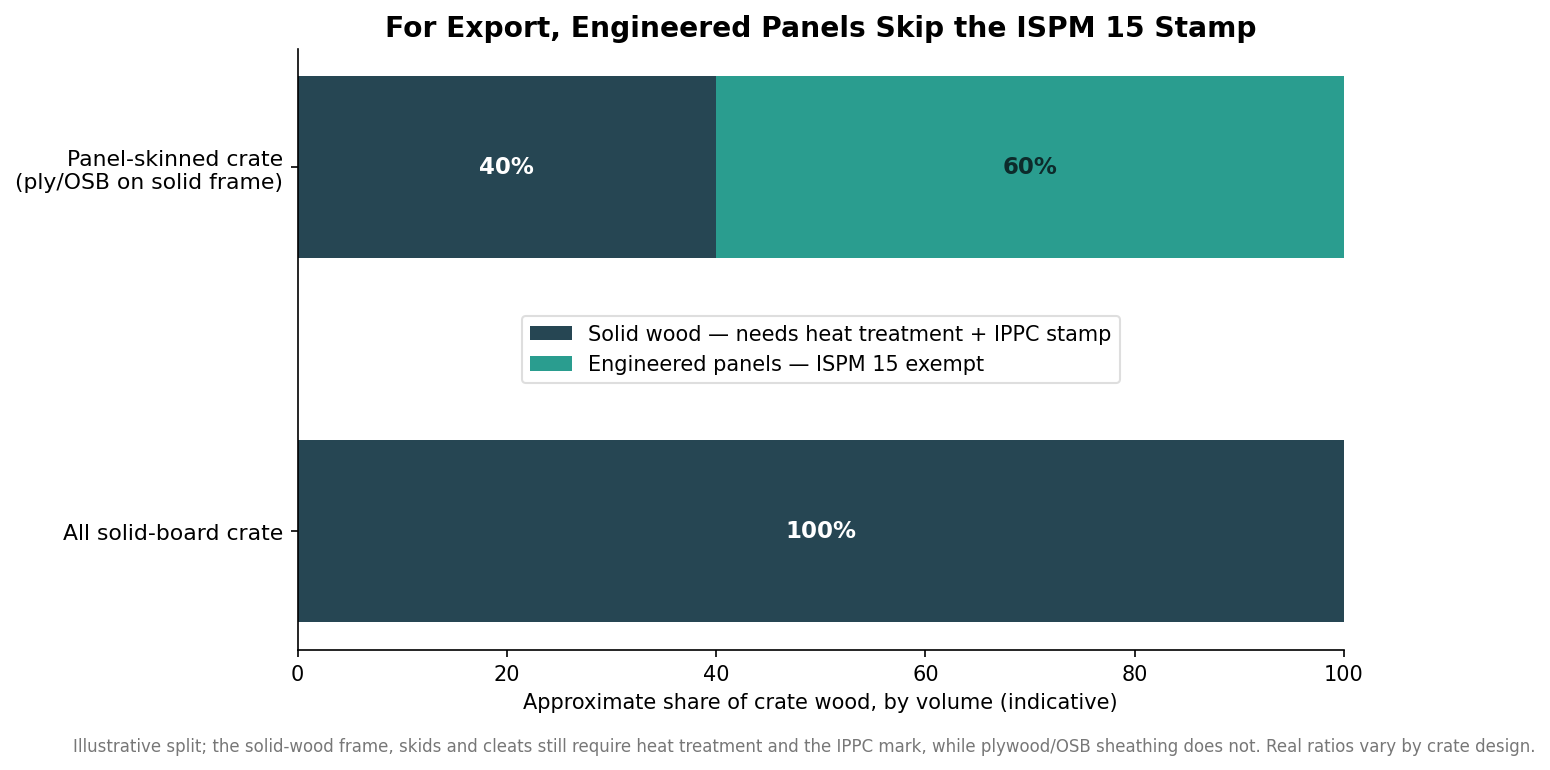
    Stacked horizontal bar chart showing a panel-skinned crate needs heat treatment on only the solid frame while an all-solid-board crate needs it entirely
    Engineered panels are ISPM 15 exempt, so panel walls cut the share of an export crate that needs heat treatment and the IPPC stamp.

    The practical consequence is that building the walls from plywood or OSB shrinks the portion of the crate that has to run through heat treatment and certification, which can trim both cost and lead time on export orders. An all-solid-board crate, by contrast, has to be treated and stamped in its entirety. The shares above are indicative and shift with the design, but the principle is firm: put engineered panels where you can, keep solid lumber to the structural frame that genuinely needs it, and you meet the export rule while carrying the least treatment burden. Spec the material first, and the size, style, and compliance decisions get easier from there.
  • Choosing a Crate Style: Open, Closed, Cleated Plywood, and Wirebound Matched to the Load

    Choosing a Crate Style: Open, Closed, Cleated Plywood, and Wirebound Matched to the Load

    A crate is not one thing. The word covers everything from a slatted frame that lets a motor breathe to a fully sheathed plywood box built to cross an ocean, and the gap between them is measured in dollars, pounds, and whether your shipment arrives intact. Once you know what goes inside and how far it travels, the style of crate almost chooses itself. This guide walks through the common construction styles, what each one protects against, and how to match the build to the load rather than paying for enclosure you do not need or skimping on protection you do.

    Why the construction style matters before the wood

    Style is the first decision, ahead of species or thickness. A crate style is really a set of trade-offs among protection, weight, ventilation, and cost. A fully enclosed build keeps out weather, dust, and prying hands but adds material, tare weight, and freight cost. An open, slatted build sheds weight and price and lets air move through, at the expense of exposing the contents. Ventilation sounds minor until you are shipping something that can trap condensation or that needs to be inspected without being unpacked. Weight matters because dimensional-weight freight pricing charges you for the box as well as the goods. Getting the style right is what keeps a crate from being both overbuilt and underprotective at the same time.

    Fasteners belong in the same early conversation. Nails are fast and common, but ring-shank nails, screws, or staples hold better under vibration and repeated handling, and a crate meant to be opened and reclosed for inspection benefits from screwed panels or a lag-bolted lid. The joining method is part of the rated strength, not an afterthought, which is why the recognized standards specify fastening as tightly as they specify sheathing.

    Open and slatted crates for rugged loads

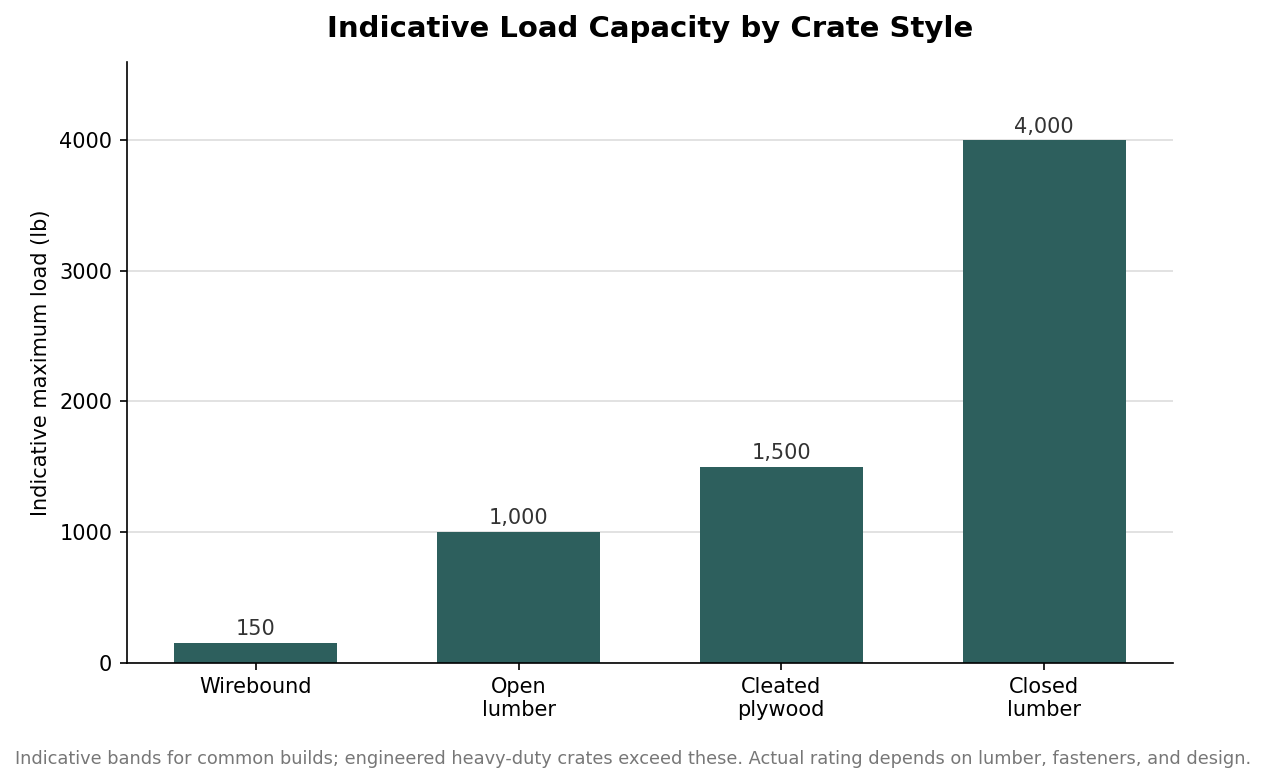
    Open crates are framed cages with gaps between the sheathing boards. They are built around a lumber skeleton and sheathed only partially, which makes them the lightest and least expensive way to immobilize a sturdy item. They suit machinery, engine blocks, fabricated steel, and other goods that are not harmed by exposure and do not need to be hidden. The open faces cut weight and cost, allow a forklift operator to see the load, and let the contents dry rather than sweat. ASTM D6039 is the recognized specification covering open and covered wood crates, and it exists precisely because these builds are engineered to a load rather than nailed together by feel. As a planning figure, common open lumber builds handle loads on the order of a thousand pounds, with heavier engineered versions going well beyond that.

    Closed and covered crates for weather and security

    Closed crates sheath every face, turning the frame into a solid box. When the contents need protection from rain, road spray, dust, or curious hands, full sheathing is the answer. Covered lumber crates carry the highest indicative load ratings of the common styles because the continuous walls add rigidity on top of the internal frame, which is why they are the default for dense, valuable, or fragile freight that will be handled repeatedly. The chart below shows how indicative load capacity climbs as you move from a light wirebound build up to a closed lumber crate. Treat the numbers as bands for typical construction, not fixed limits, because a properly engineered heavy-duty crate can be designed far past them.

    Bar chart of indicative maximum load capacity by wooden crate style from wirebound to closed lumber
    Indicative load bands rise from light wirebound builds to fully closed lumber crates.

    Cleated plywood boxes for a strong, lighter export shell

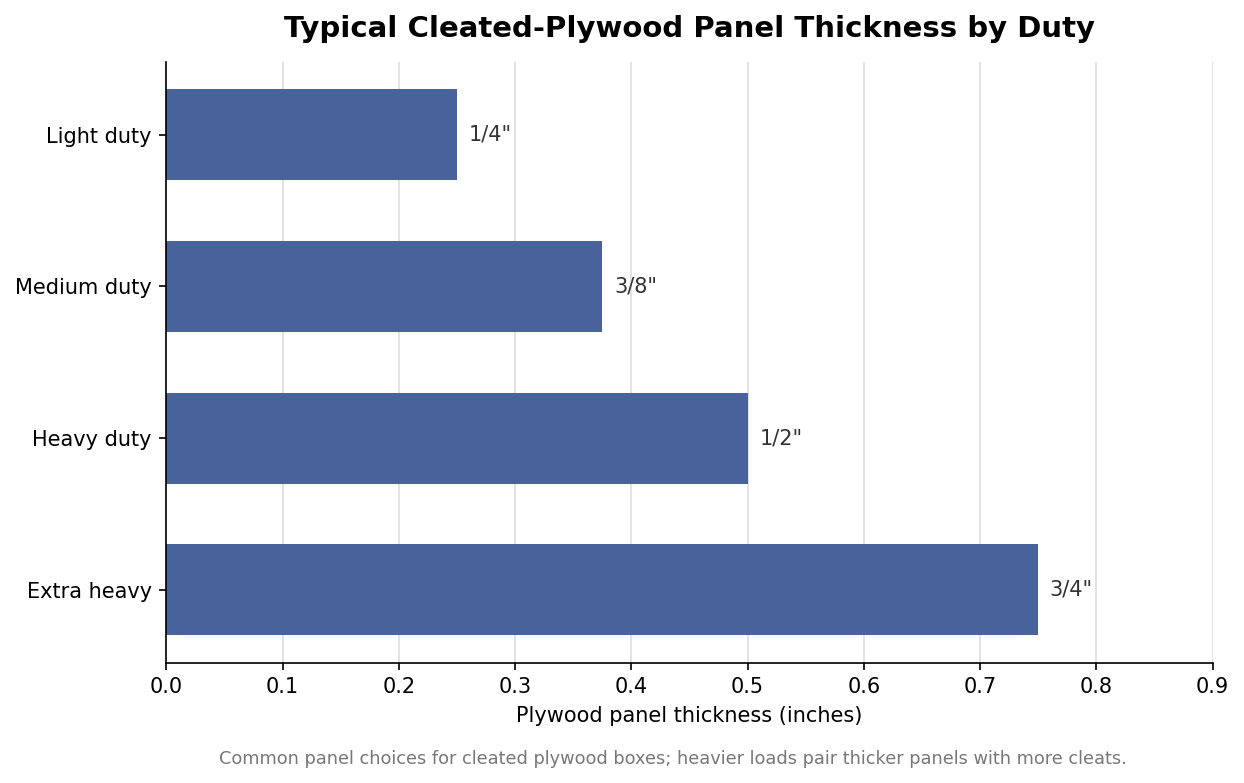
    Cleated plywood boxes trade solid boards for plywood panels braced by wood cleats. The panels give you a smooth, continuous wall while the cleats supply the stiffness that a bare sheet lacks, and the result is often lighter than a solid-lumber crate of the same strength. That weight advantage is why cleated plywood is a workhorse for export, where freight is priced by weight and volume and where ASTM D6251, the specification for wood-cleated panelboard shipping boxes, sets the construction rules. Panel thickness is the main lever: lighter loads ride on quarter-inch panels, while heavy contents call for half-inch or thicker plywood paired with more closely spaced cleats. The second chart shows how panel thickness typically steps up with duty.

    Horizontal bar chart of typical cleated-plywood panel thickness by duty level from quarter inch to three quarter inch
    Plywood panel thickness for cleated boxes typically steps up with the duty.

    Wirebound crates, and how a crate differs from a pallet

    Wirebound crates are the light end of the range. Thin wood faces are stitched together with steel wire so the crate can ship flat and be assembled quickly, which suits produce, light parts, and anything where low cost and collapsibility outweigh brute strength. They are not built for heavy or high-value freight, and the indicative load band reflects that. Their real advantage is logistics: because they ship and store flat, they save space and freight on the inbound side and assemble in seconds when you need them. It is also worth being clear about a distinction that trips up a lot of buyers: a pallet is only a base for forklift handling, and a skid is a base without bottom deck boards, whereas a crate encloses the load with sides and usually a top. Many heavy crates are in fact built on a skid base, combining forklift access underneath with full enclosure above. If your goods need containment rather than just a platform to lift from, you need a crate, and choosing the style above is the real decision.

    Put the pieces together in order. Start with the weight and fragility of the contents and whether they must be sealed from weather or left to breathe. That points you to open, closed, cleated plywood, or wirebound. Then size the crate to the load, set panel or sheathing thickness to the duty, and, if the shipment leaves the country, confirm the build meets the export standard and the wood is ISPM 15 compliant. Specified in that sequence, the crate protects what matters without carrying cost you do not need.

  • ISPM 15 Crates: What Export Wood Packaging Has to Meet

    ISPM 15 Crates: What Export Wood Packaging Has to Meet

    If your product leaves the country in a wooden crate, the crate is regulated cargo before it ever holds anything. A raw pine board can carry bark beetles, longhorn borers, and pinewood nematodes across borders, so almost every trading nation now demands that solid-wood packaging be treated and marked before it crosses a frontier. The rulebook is a single international standard, and a crate that ignores it can be refused, fumigated, or sent back at the shipper’s expense. This is a plain walk-through of what that standard asks for, so you can specify an export crate that clears customs the first time.

    Why one standard governs wooden crates worldwide

    The standard is ISPM 15, short for International Standards for Phytosanitary Measures No. 15, published by the International Plant Protection Convention. Roughly 180 countries enforce it, including the United States, Canada, the European Union member states, China, and Australia, which means it effectively governs any solid-wood crate, pallet, skid, or piece of dunnage moving in international trade. The goal is narrow and specific: kill any pests living in the wood so packaging does not become a vector for invasive species. It does not care what you ship inside the crate; it cares only about the wood the crate is built from.

    Two points trip up first-time exporters. The rule applies to the packaging, not the goods, so even a shipment of finished metal parts needs a compliant crate. And it applies at the border of the destination country, not your own, so a crate that is fine for a domestic move can be rejected the moment it is booked for export.

    What “heat treated” actually means

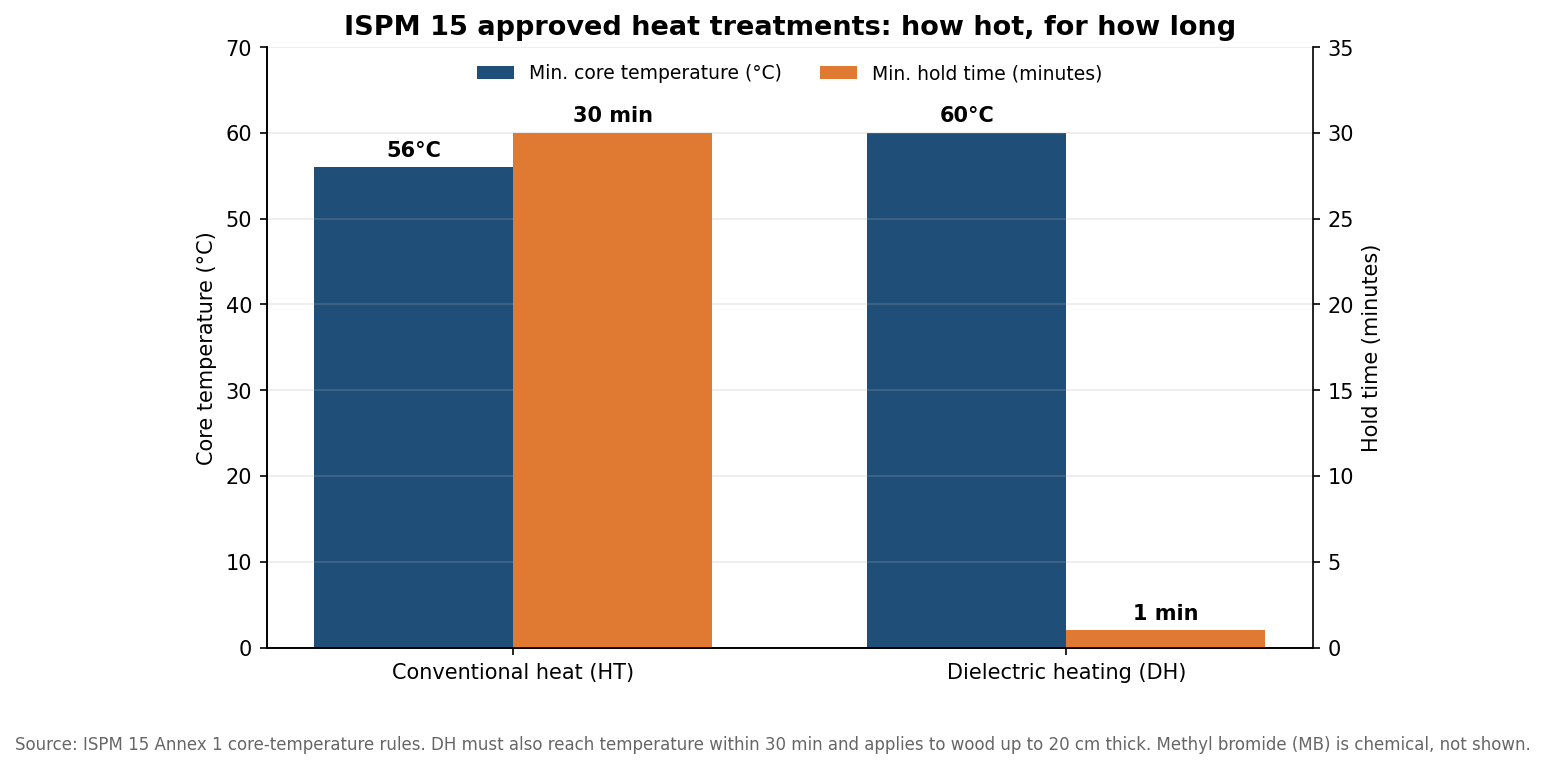
    The most common way to satisfy ISPM 15 is heat treatment, abbreviated HT. The wood has to reach a core temperature of at least 56 degrees Celsius, about 133 degrees Fahrenheit, and hold there for a minimum of 30 continuous minutes. Note the word core: it is not the surface or the kiln air that matters but the center of the thickest piece, which is why treaters probe the densest members. A newer option, dielectric heating (DH), uses microwave or radio-frequency energy to drive the core to at least 60 degrees Celsius for one continuous minute, reaching temperature within 30 minutes, and is limited to wood up to 20 centimeters thick.

    Bar chart comparing ISPM 15 heat treatment at 56C for 30 minutes versus dielectric heating at 60C for 1 minute
    The two heat-based ISPM 15 treatments and the core temperature and hold time each requires.

    The chemical alternative is methyl bromide fumigation, marked MB, but its use is being phased down in many regions because it depletes ozone, so heat treatment is the default most buyers should expect. Heat treatment also leaves the wood dry and dimensionally stable, which is a quiet advantage for a crate that will sit in a humid container for weeks. Treatment does not make wood waterproof or rot-proof; it is a one-time pest kill, and wood can be re-infested later if it is stored badly, which is one reason the marking and handling rules exist.

    Which crates need treatment, and which are exempt

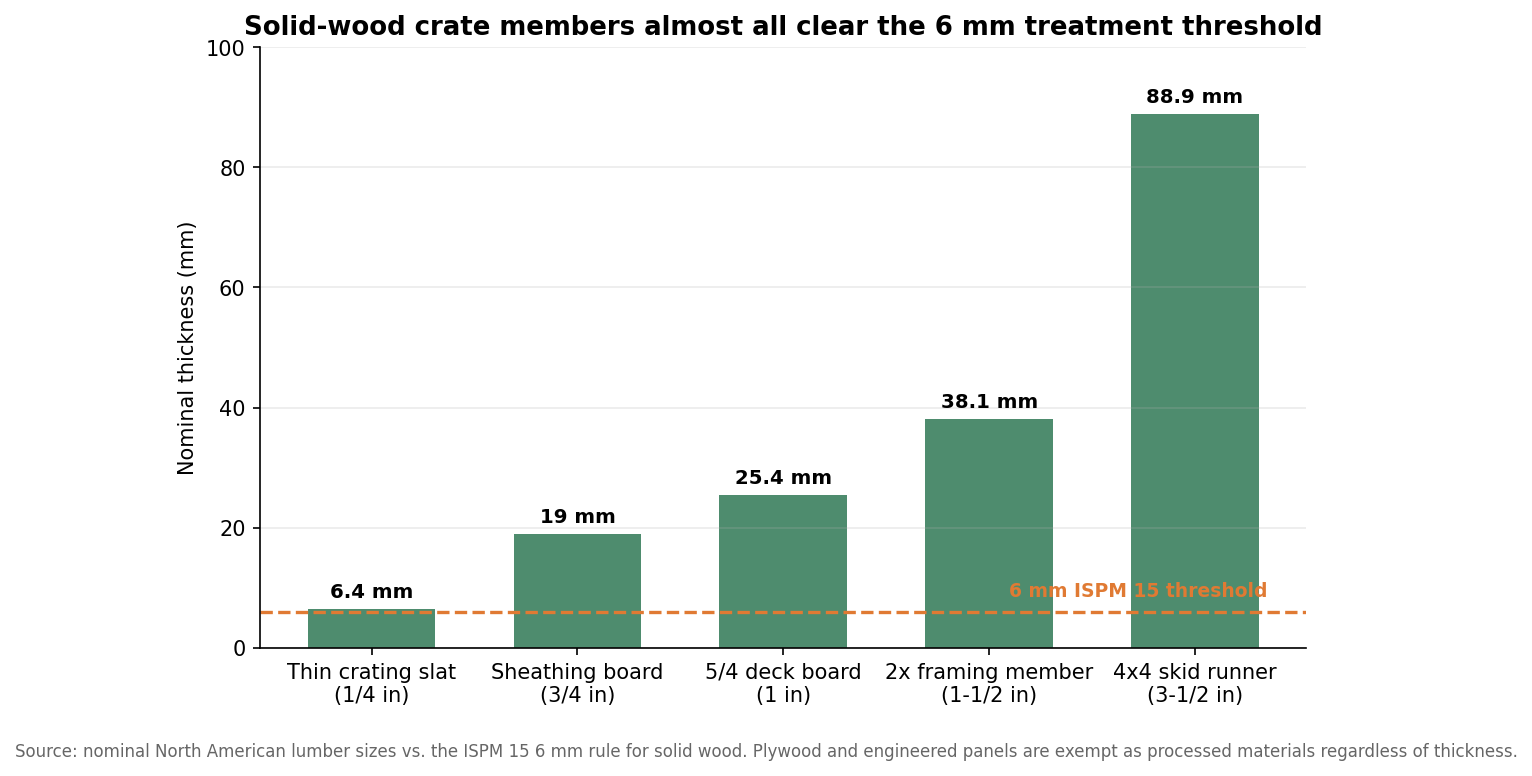
    ISPM 15 covers solid-wood components thicker than 6 millimeters. That threshold sounds generous until you measure real crate lumber: a three-quarter-inch sheathing board is 19 millimeters, a two-by framing member is about 38 millimeters, and a four-by-four skid runner is nearly 90 millimeters. Every structural piece in a normal solid-wood crate clears the line comfortably, so in practice a solid-wood export crate always needs treatment.

    Bar chart of nominal solid-wood crate member thicknesses against the 6 mm ISPM 15 threshold
    Common solid-wood crate members measured against the 6 mm treatment threshold.

    The important exemption is by material rather than size. Plywood, oriented strand board, and other engineered or processed panels are exempt because the heat and adhesives used to manufacture them already destroy pests. That is a genuine specifying lever: a crate clad or built in plywood can sidestep the treatment-and-stamp requirement on those panels, though any solid-wood framing or skids still fall under the rule. Compliant wood must also be debarked before treatment, since bark is where many insects live and lay eggs, so a small amount of residual bark is tolerated but strips beyond the allowed size are not.

    Reading the stamp before your crate ships

    A treated crate is proven by a mark, not a certificate that travels separately. The stamp carries the IPPC wheat-stalk logo, a two-letter ISO country code for where the treatment happened, a unique registration number for the facility that treated the wood, and a treatment code: HT for heat treatment, DH for dielectric heating, or MB for methyl bromide. The mark has to be legible, permanent, and applied to at least two opposite sides of the finished crate. It should never be handwritten or drawn in a color that suggests a food or hazard marking.

    When you receive an export crate, the fastest quality check is to confirm the stamp is present on two sides, that the treatment code matches what you ordered, and that the facility number is printed rather than penciled. A missing or ambiguous stamp is the single most common reason compliant-looking crates get held, because the inspector at the destination port reads the wood, not your paperwork.

    Specifying an export-ready crate

    Bring three things to the conversation and the rest follows. State that the crate is for international export so the builder treats and stamps it rather than assuming a domestic job. Give the gross weight and the dimensions of what goes inside, since those drive lumber gauge and whether you need a heavier skid. And decide early between a solid-wood build and a plywood-clad build, because that choice changes both the treatment scope and the crate’s own weight, which you pay to ship.

    Treatment and stamping add a step to the build, so an export crate generally carries a modest surcharge and a little extra lead time over a domestic one; the exact figures depend on size, volume, and how the builder schedules its treatment, so treat any single number as indicative and confirm it on a quote. The cost of getting it wrong is not modest, though. A non-compliant crate at the destination can be rejected, fumigated, or destroyed on arrival, with the fees and the delay landing on the shipper. Specifying the standard up front is far cheaper than discovering it at a foreign port.

  • Engraved or Printed? What Actually Survives on a Wooden Crate

    A crate gets handled, stacked, dragged and stored. Whatever you put on it has to survive that, and the three methods behave very differently.

    Laser engraving

    The laser burns the mark into the grain, so it is a permanent feature of the surface rather than a layer on it. It cannot rub off, it does not scuff at the edges where a crate takes its knocks, and it darkens slightly with age as the wood does.

    It holds fine detail well — considerably finer than most people expect on pine — but it is monochrome. The mark is the colour of scorched wood, and no amount of asking will make it your brand blue.

    Screen printing

    Printing gives you colour, and that is the only reason to choose it. On a crate that will be handled it starts scuffing at the corners within weeks and looks tired within a season.

    If the crate is a single-use presentation piece that will be photographed once and then kept indoors, printing is defensible. For anything reused, it is not.

    Branding irons

    The traditional method, and it looks it: a heavy, slightly uneven burn with a lot of character. It is genuinely charming on rustic products and hopeless for fine detail, because the iron has to be a physical relief plate.

    It also costs a tooling charge per design, which laser engraving does not.

    How to choose

    Reused crate: engrave. Colour is essential to the mark: print, and accept the lifespan. Rustic single mark with no fine detail and a long production run: an iron is worth considering.

    We will tell you which we think your artwork wants, including when that answer is the cheaper one.

  • Using Wooden Crates as Retail Display Fixtures

    A crate on a shop floor is a fixture, not packaging. Judged as a fixture, most crates fail on three specific points.

    The angle is the whole trick

    A flat crate presents its contents to the ceiling. An angled base tilts the front up toward the shopper, and that single change is the difference between a crate of produce and a display of produce.

    It costs very little and it is the first thing we recommend to anyone merchandising from crates.

    Restocking is the real test

    A display fixture gets emptied and refilled twice a day. Corners take the abuse, so they need reinforcing, and edges need easing or staff catch their hands and stop using the fixture properly.

    Ordinary shipping crates do not survive this. They were built to be filled once.

    Consistency across stores

    The quiet failure in multi-store rollouts is crates sourced locally per branch: eleven stores, eleven slightly different timbers, finishes and dimensions. It reads as scruffy even when nobody can say why.

    We keep the design and finish on file so a store opening two years later gets the same fixture as the first.

    Freight, which decides the budget

    Assembled crates ship air. Flat-packed crates ship dense, and on a rollout the freight saving routinely exceeds the entire cost of upgrading the crate. They assemble in under a minute each with a mallet.

    Where to put the mark

    The front face, not the end and not the lid. That is the face the aisle sees, and it is the only one that earns its keep on a display fixture.

  • Sizing a Crate: Start With What Goes Inside

    Almost every disappointing crate order comes from picking a listed size instead of measuring the contents. In wood, bespoke costs nothing extra.

    Measure the contents, then add clearance

    Take the widest, deepest and tallest points of what goes in. Add roughly a quarter-inch of clearance per side for a snug presentation fit, or an inch if the crate is being packed by hand at speed.

    Send us those numbers, or simply tell us what the product is. Either is enough.

    Decide about dividers early

    Anything that can knock against its neighbour in transit needs separating. Timber dividers look considered and cost a little; cardboard dividers cost less and cheapen the moment the lid opens.

    For bottles, dividers are effectively mandatory. For soft goods they are usually unnecessary.

    Think about the stack

    If crates will be stacked, the footprint should be consistent and the corners reinforced, or a full stack racks and leans. If they will be palletised, size the footprint so a whole number of crates fits the pallet — a crate that wastes four inches of pallet width costs you that space on every shipment forever.

    Think about the hand

    A crate that will be carried full should be sized to what a person can actually lift. Beyond roughly forty pounds you want rope handles at minimum, and beyond that you want a smaller crate rather than a stronger back.

    What to send us

    Contents or dimensions, whether it stacks, whether it travels, and roughly how many. That is a complete brief, and it comes back as a free mockup within one business day.